
Why Some Homes Feel Instantly Better, Even Before You Notice Why
Why do some homes feel right the moment you walk in? The answer depends on airflow, scale, and light—and getting them wrong is hard to fix later.
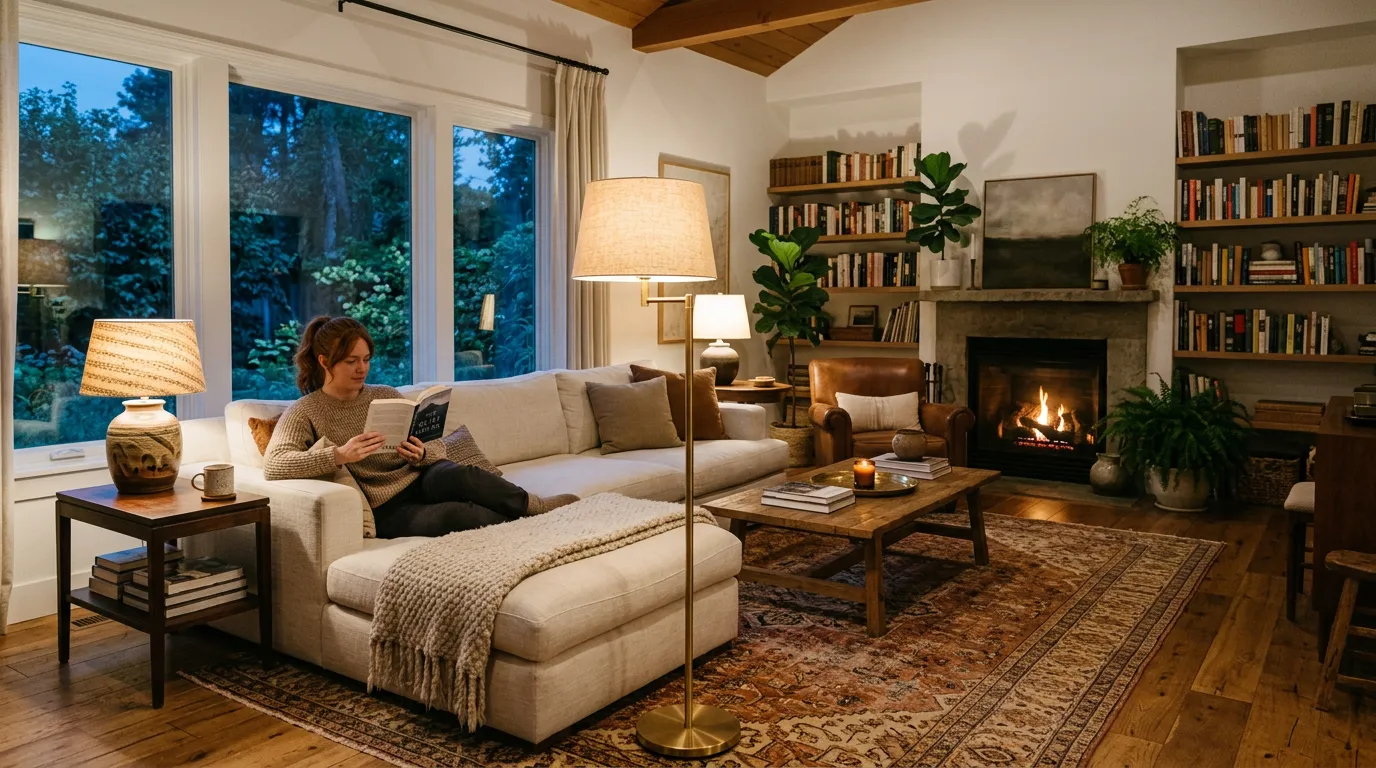
Interior designers will tell you to check ceiling height before they discuss paint colors, and there's a reason for that. The variables that make a home feel right operate below conscious attention. You've walked into a house and felt at ease before registering the furniture, before reading the room. You've also walked into a perfectly decorated space that felt slightly wrong, and couldn't explain why.
That gap between feeling and explanation is where most home advice stops. It covers style, color palettes, the right throw pillow. It skips the physical mechanics that govern comfort before your eyes fully adjust.
What actually drives that first-impression feeling is a set of environmental variables—light quality, spatial scale, acoustic texture, and airflow—that most design guides fold into vague advice about "atmosphere." The tension worth sitting with: the elements most responsible for how a home feels are also the least photogenic, which is why they're systematically underrepresented in the content that shapes how people spend money on their homes.
The Physical Variables That Register Before Thought
Light is doing more work than people give it credit for. Not just brightness—the angle, color temperature, and the number of light sources in a room all affect whether the space reads as comfortable or clinical. A room lit from a single overhead source at 5000K (daylight-white) will feel institutional even if the furniture costs ten times more than a room with three lower sources at 2700K (warm-white). The brain is categorizing the environment before you've formed a single conscious opinion about it.
Acoustic texture is the variable almost nobody talks about. Hard surfaces everywhere—stone floors, bare drywall, no textiles—produce a slight reverb that the nervous system reads as exposure. Not loudly. Quietly, persistently. Rooms with rugs, upholstered furniture, and curtains absorb mid-frequency sound in a way that signals enclosure and safety. It's not about silence; it's about the quality of the sound that remains.
Or rather: it's not just about soft surfaces dampening echo. It's about the ratio of reflective to absorptive materials reaching a point where sound doesn't bounce before you've finished speaking. Rooms that feel immediately comfortable tend to have that ratio in balance without looking deliberately acoustic-treated.
Spatial scale matters in ways that go beyond square footage. A small room with an 8-foot ceiling and correctly proportioned furniture can feel more comfortable than a large room where the furniture is too small for the space, which makes the walls feel recessive and the occupants feel exposed. Scale mismatch is one of the most common reasons a home that photographs well feels off in person.
What This Actually Means for Your Home
The practical implication is that stylistic upgrades—new art, different paint, better furniture—will underperform if the foundational variables are wrong. Repainting a room that has one ceiling fixture and bare floors will make it look different. It won't necessarily make it feel better.
If you want to change how a room feels, check these first: light source count and color temperature, floor coverage percentage, and whether furniture scale relates to ceiling height rather than just floor area. Three inputs, and getting even one of them right can shift the room more than a full redecoration.
What you'll notice when you compare two rooms that feel different despite similar budgets is that the comfortable one usually has more light sources at lower wattage rather than fewer sources at higher wattage. That distribution creates the shadow gradients that the brain associates with shelter—the way candlelight or a fire reads as comfortable, not because of nostalgia, but because pools of light with soft shadows signal a bounded, intimate environment.
This is where the gap between design content and design reality is largest. A styled photo maximizes visual interest. A comfortable room maximizes perceptual ease. Those goals conflict more often than they align, and the people who find their renovations disappointing are often the ones who optimized for the photo.
The One Upgrade That Changes the Feeling, Not Just the Look
If there's a single category of home improvement that is chronically undervalued relative to its effect on how a home feels, it's lighting layering. Adding a floor lamp and a table lamp to a room that has only overhead lighting costs less than a new sofa and changes the felt experience more fundamentally. The overhead light becomes the utility layer; the lower sources become the comfort layer. Using them selectively by time of day means the same room serves both functions.
Rugs are second. Not for style—for acoustic and tactile reasons. A rug large enough that the front legs of all major furniture sit on it (the common guideline for sizing) does something measurable: it reduces reverb, adds thermal mass at floor level, and provides a visual anchor that makes furniture feel intentional rather than placed. Ignore the styling rules about rug color. Focus on whether it's large enough to do the functional job.
Air movement is the one most people skip entirely. Ceiling fans have a terrible reputation for aesthetics, but the alternative—still air that stratifies by temperature—is one of the most reliable sources of low-grade discomfort in American homes, especially in rooms with high ceilings. A fan at low speed on a warm day changes thermal perception by 3 to 4 degrees Fahrenheit without changing the actual temperature. That's a practical heuristic from HVAC convention, not a guaranteed number, but the directional effect is well-supported.
What happens if you ignore all of this? The home gets redecorated periodically and never quite feels right. Not dramatically wrong—just slightly off, enough that you keep looking for the solution in the next purchase. That cycle is expensive and it doesn't end until the foundational variables get addressed.
When the Comfortable-Home Formula Doesn’t Apply
These principles work for most people in most residential contexts. They're less useful if you're staging a home for sale rather than living in it, where visual impact in photographs outweighs tactile comfort. They also assume the structure of the home is reasonably sound—a home with moisture problems, inadequate insulation, or HVAC issues will feel wrong regardless of how thoughtfully it's furnished, and no amount of acoustic textiles fixes a 58-degree room in January.
Renters face a harder version of this problem. Lighting is addressable—plug-in fixtures, smart bulbs, floor lamps. Acoustics are addressable through textiles. Spatial scale and airflow are not always changeable without landlord permission. Knowing the limit of what you can control is more useful than trying to optimize around structural problems you can't fix.
The Uncomfortable Truth About Home Design Content
The things that make a home feel better are boring to write about and ugly to photograph. Light temperature, acoustic ratios, and furniture scale don't generate content that performs on Pinterest. So the internet is full of advice about color palettes and styling, and thin on the mechanics that actually govern whether someone feels comfortable spending time in their home.
I'd start with a single evening: turn off every overhead light in your main living space, turn on every lamp or secondary light source you own, and notice whether the room feels different. If it does—and it almost certainly will—that's the experiment that tells you where to spend next. Not on more things. On the right kind of light, at the right height, at the right temperature. That change costs less than most people expect and solves more than they anticipate.
The best homes don't announce themselves. They make you feel settled before you've processed why, and you only notice the quality of the furniture after the environment has already made you comfortable. That sequence—environment first, objects second—is the one worth designing for.